
Poverty Mitigations

How to stop poverty in the Philippines?

So how to end poverty in our country? Can we dictate the Philippine islands to have fear in God? Should we go to the streets and shout night and day to the Malacañang Palace they need to become God-fearing? Or shall we teach ourselves to have fear in God? The Philippines are made of Filipinos. Hence, if we want to end poverty in the Philippines, we need to end poverty in all the Filipinos. And who is the nearest Filipino from you? Isn’t it yourself? Therefore, to end poverty in our country, we must start ending our own poverty – we must start to have fear in God within ourselves.

Now, what will fear in God cause us? Will it make us slaves and take away our freedom? The answer is that it will make us slaves and free at the same time. The fear of the Lord will make us slaves of diligence, wisdom, righteousness, kindness, self-control, patience and love. However, it will also make us free from indolence, foolishness, deceit, selfishness, lack of self-control, impatience and hatred. In other words, it will cause us to make God our Master, while rejecting the evil. If all the Filipinos have fear in God, they will obey God’s commands. God commanded us to be patient, honest, diligent, humble, knowledgeable, wise and understanding – all of these will overcome our poverty and will give us riches in life.

If all our workers are diligent, if all our political leaders are honest, if all the voters are wise, if all the business owners are not greedy, and if all the spiritual leaders are selfless who teach the right religion, then we might be living in a rich country. All of these could happen if we truly have fear in God, and if we really God love by following His commandments.

Going back to the definition I shared, which says poverty is “the lack of principles, attitudes, values, actions and habits to become rich”, the fear of the Lord will give us wisdom which are made of powerful principles. These principles will give us the light to guide us in making the right decisions in life towards development. When we made the right decisions, we make the right actions that will make our lives better. And when we practice those actions consistently, those become our habits shape our lives to long-term development, personally, spiritually and financially.

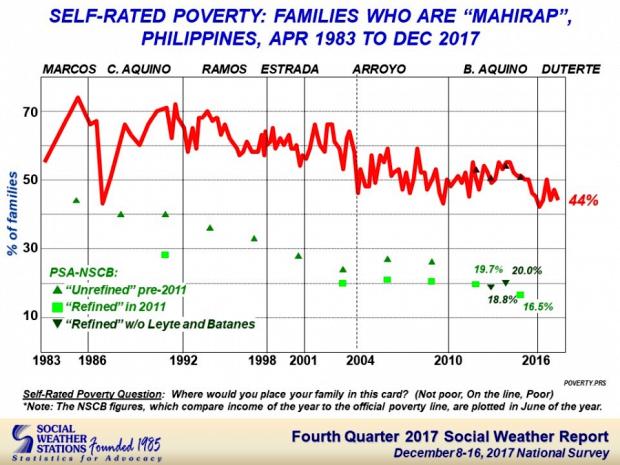
Poverty Statistics 2018 PH

Philippines’ Poverty Rate Declines; More Well-Paying Jobs and Opportunities Needed

https://www.worldbank.org/en/news/press-release/2018/05/30/philippines-poverty-rate-declines-more-well-paying-jobs-and-opportunities-needed

MANILA, May 30, 2018 – With solid economic fundamentals, the Philippines is well-placed to speed up poverty reduction. The challenge is to provide more economic opportunities, which would help many more people earn higher and stable incomes.

These are among the key findings of the report titled Making Growth Work for the Poor: A Poverty Assessment for the Philippines released today by the World Bank.

From 2006 to 2015, the latest available data, the report says that robust economic growth helped the poverty rate in the Philippines to fall by 5 percentage points. Poverty declined from 26.6 percent in 2006 to 21.6 percent in 2015, due to factors like the expansion of jobs outside agriculture, government transfers, in particular to qualified poor Filipinos through the Pantawid Pamilyang Pilipino Program, and remittances.

“This experience gives us hope that the Philippines can overcome poverty,” said Mara K. Warwick, World Bank Country Director for Brunei, Malaysia, Philippines, and Thailand. With a strong economy, the country is well-placed to end the vicious cycles of unequal opportunity that trap people in poverty, set in place measures to improve service delivery, and boost job opportunities.”

In 2015, some 22 million Filipinos—more than one-fifth of the population—still live below the national poverty line. Constraints to achieving faster poverty reduction, according to the report, include the less pro-poor pattern of growth; high inequality of income and opportunities; and the adverse impacts of natural disasters and conflict.

Most poor Filipinos have low levels of education and live in large households headed by individuals who are self-employed or work in agriculture as laborers or smallholder producers. The poorest households are those dependent on agriculture as their main source of income and most of them live in the countryside, in areas prone to disasters or in the conflict-affected areas of Mindanao.

“Making a difference in Mindanao makes a big difference to the Philippines. Increasing public investment in Mindanao to boost development there would expand opportunities for conflict-affected communities, broaden access to services and create more and better jobs,” said Xubei Luo, Senior Economist at the World Bank’s Poverty and Equity Global Practice.

Inequitable investment in human capital and insufficient well-paying job opportunities trap the poor in poverty across generations, the report explains. High concentrations of wealth constrain equal opportunities and access to services, which are necessary for inclusive growth. Natural disasters disproportionately and repeatedly batter the poorest regions of the country, miring them in higher levels of poverty.

The government has prepared strategic plans focused on reducing poverty, specifically AmBisyon 2040, a long-term vision to bring down poverty and improve the lives of the poorest segments of the population, and the Philippine Development Plan 2017–2022.

These plans target reducing poverty to 13 to 15 percent by 2022. To help achieve these targets, the Poverty Assessment recommends the following policy directions:

•           Create more and better jobs;

•           Improve productivity in all sectors, especially agriculture;

•           Equip Filipinos with skills needed for the 21st century economy;

•           Invest in health and nutrition;

•           Focus poverty reduction efforts on Mindanao; and

•           Manage disaster risks and protect the vulnerable.

Poverty : Are we rising from or going down ?

Poverty is universal issue every country has to deal with. All governments are taking effective measures, and platforms for people to obtain their welfare. However , where do you think poverty is suppose to end? If given the choice , none would have to continue living by it. Why do people have to struggle and fight for proper health, good nutrition , adequate resources ,quality education and a fulfilling career?

We are centered with our personal lives to get a better revision of our current situations esp. of the financial aspect. Let’s accept poverty is in the midst. Abandoned children at our midst, families who cannot sustain their daily intake of food, individuals who sleep by the streets  , and even businessmen whose businesses are at risk of bankrupcy.

With all of what the dark sides our society makes us realize , how can we even tell if the whole human race is rising from poverty or getting worst at it ? Even government programs fail and reverse the good pupose by which they establish laws and implementations.

Are rising from or going down ? The Government cannot eradicate poverty by all means. It just does mitigate it somehow. We don’t have the choice to choose between poverty and abundance. Therefor, if I would have to assess its balance, poverty has never moved way much higher or lower . It stays by evident and irrevocable in our eyes. But what can we mitigate?